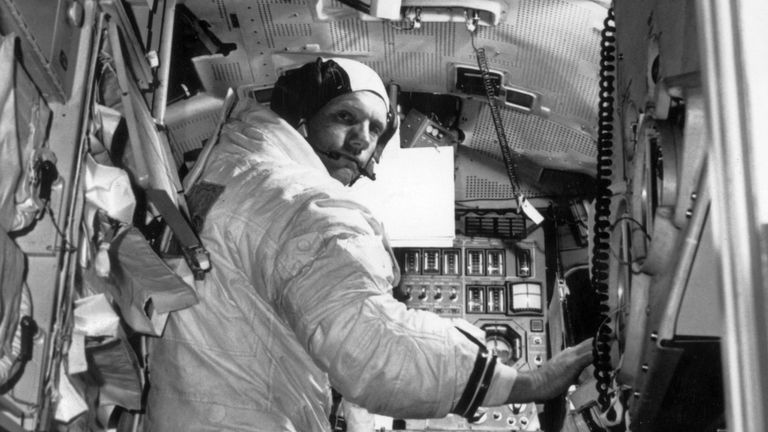
It was great to see so much space stuff on tv, in the press and at the cinema. You would imagine there isn’t much left to be said about it all, but there were new things, and certainly things forgotten.
The BBC has the regular long running The Sky at Night and it was great to see James Burke talking about his work on tv at that time.
Sadly many like Patrick Moore, Walter Cronkite, Arthur C Clarke and many others are long gone. And one of the prime movers of the USA space programme, Chris Kraft, died just the other day, as the celebrations were proceeding.
There was, of course, a space war. A war with Russia and the USA. Facts come out about what the Russians intended to do. It is always said that they intended to land a man on the Moon before the USA, but the evidence that this is a real threat is very sketchy. Certainly, the Luna 15 unmanned craft was intended to get to the Moon, retrieve samples and return before Apollo 11 succeeded, but it crashed on the Moon’s surface.
Remember, no person of any nationality other than American has walked on the Moon, and no woman has. Had the Apollo series continued, that might have happened.
You can ask the question, what was the point of space exploration and Apollo 11, what did it achieve?
In some ways, superficial things. In many ways, it was a deeply profound, great achievement in history.
It fulfilled Kennedy’s challenge.
It was great PR.
It beat the Russians in the cold war space race.
Geological samples started to give us new insight into the Earth, our origin, the universe.
New manufacturing techniques, new things that were invented for space exploration, have impacted our lives ever since. No, not just non-stick frying pans, but heart pacemakers, home computers, cell phones, the Internet, communications satellites, velcro, artificial limbs, the list is almost endless.
But, it proved it could be done. Man has finally taken a step off our home world.
No, wait. I know that the success of Apollo 11 was not just down to him. There were hundreds of thousands of people who contributed over the years, and a crew of three not just one.
Armstrong was the gold standard of NASA astronaut, but all three on this mission were of the highest class. While Collins is fairly chatty, and even now has a twinkle in his eye when he talks about space, the other two were quiet and reserved. This is surely why they were picked – a laughy, jokey crew in space may well have been entertaining, but had something gone wrong, and it did, fingers would be pointed. NASA wanted to give the mission the best chance to succeed, and it did.
Of course, the whole world was watching them. Literally.
I have never had the privlege of meeting any astronaut. I know they are a special class of person.
Neil Armstrong had been on previous missions. He had a track record of dealing with issues in a cool, calm and methodical way. he was a person who was not easily flustered, could make decisions under pressure, a highly intelligent man.
I am not saying anything against any other astronaut or cosmonaut. But, if landing on the Moon is one of the greatest achievements in human history, if not THE greatest, then only one man can be the first in all of history to walk on another celestial body first, and it was Armstrong. There can only be one first.
When the lunar module was coming in to land, computer errors were a distraction and a possible abort situation arose more than once. Approaching the landing spot, Armstrong decided it was unsuitable, so manually landed the ship with barely seconds of fuel remaining. This ability to act so coolly saved the mission, and possibly their lives.
Armstrong was the first down the ladder. I am sure I read somewhere that his boot actually touched the surface by accident before the ceremonial stepping off the LEM, but I can’t find that now. He said his famous words. He took a sample of soil, looked around a bit, then was joined by Aldrin.
They had been required by law to post a USA flag up there, a claim for American soil, as ever. They took a call from Nixon, someone who had had nothing to do with the space programme, trying to get in on the act as ever.
They deployed experiments, took samples and photographs. Then it was home time, in less than 24 hours.
I used to belong to the British Interplanetary society. Someone once asked if there were any photographs of Armstrong on the Moon, not tv pictures but actual photos. I believe some were found by Douglas Arnold.
Then they were back, listening to Nixon again, going on about sports, and all three lives had been changed forever, but especially Neil Armstrong’s.